
A Contemporary Refuge in León | Gálvez House by Estudio Villagálvez

Author: Pablo Vazquez.
A lover of discovering new places and a workaholic, in short, an architect.

Project: Casa Gálvez.
Architects : Estudio Villagálvez.
Project Year: 2025.
Location: León, Guanajuato, Mexico.
Area: 230.00 m2.
Photographs: Jorge Succar.
Landscaping: Latika landscaping.
Proveedores: Interceramic, Cemex, Unik.
Amidst the urban dynamism of León, Guanajuato, a house emerges that chooses tranquility over noise, shade over excess, and contemplation over immediacy. Casa Gálvez, designed by Estudio Villagálvez under the direction of Christian Mauricio Villanueva Gálvez, stands as an architectural response to a saturated context, where the green landscape—scarce yet essential—becomes the starting point for a profoundly human spatial narrative.
“Architecture should not impose itself on the environment, but rather engage in dialogue with it.”
I could summarize the philosophy behind this 230 m² project, which transforms the site's conditions into a virtue: the proximity of an industrial area is balanced by the respite offered by a strip of mature vegetation, dominated by a tabachín and a eucalyptus tree that not only accompany the construction, but define it.

The Tree as Architecture

From the very first approach, the royal poinciana becomes the true protagonist. It is not just vegetation: it is a threshold, a guide, and a symbol . Its presence marks the beginning of the journey, a transition between the natural and the built environment.
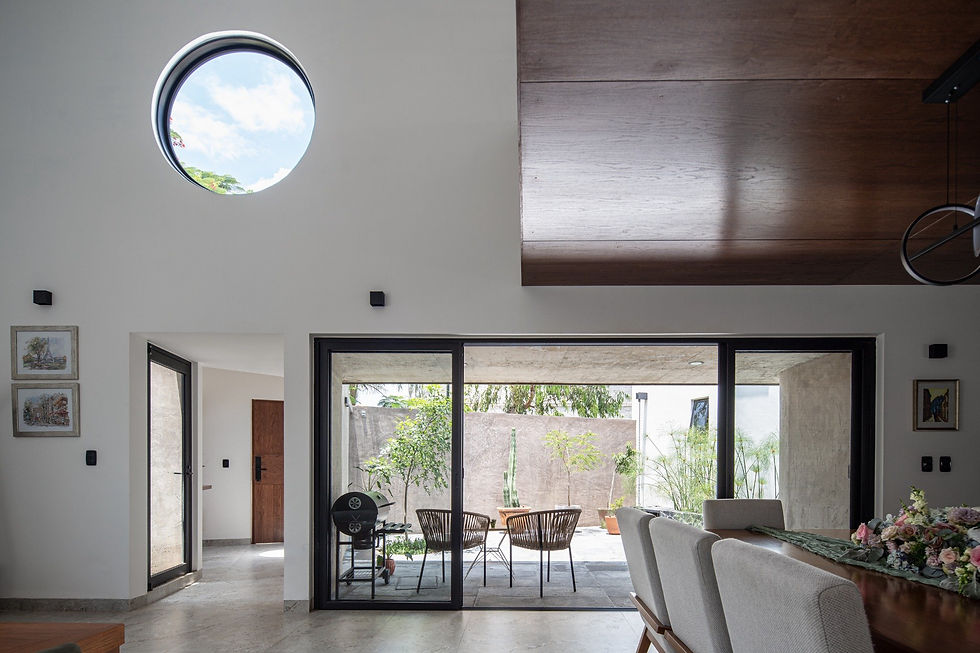
Under its shadow begins the access experience, which passes through a contemporary entrance hall , where the exposed concrete and a circular oculus in the slab filter the light in a theatrical way, cutting the shadows of the foliage on the gray surfaces.
This space functions as both a prelude and a pause : a threshold between the urban exterior and the intimate universe of the home. Here, the architecture reveals itself in layers, slowly unveiling itself through light, reflections, and material silences.
The suspended granary: memory and modernity
The heart of the project is a contemporary reinterpretation of the Mexican troje , that rural structure that symbolized shelter, community, and harvest. In Casa Gálvez, the troje is transformed into a suspended volume that houses the home's social area : kitchen and dining room on the ground floor, and a television room and study on the upper level.
This gesture not only creates a visual relationship between the levels, but also promotes coexistence , allowing domestic life to take place in a continuous, dynamic and luminous space.

The use of natural wood as the main material lends warmth and texture to the whole, contrasting with the austerity of the exposed concrete and the sobriety of the urban environment. Thus, the “suspended granary” is not only a formal element, but a metaphor for the contemporary home : one that protects without isolating, that opens without exposing itself, and that finds in light and matter a poetic way of inhabiting.
The courtyard as a bioclimatic heart

As in many homes in the Bajío region, the central courtyard becomes the heart of the house. Its function transcends aesthetics: it acts as a thermal and emotional lung , promoting cross-ventilation, solar control, and a direct connection with the landscape.
Its warm-toned walls protect the privacy of the interior, but its upper opening allows the canopies of the tabachín and eucalyptus trees to dominate the view.
From every vantage point, nature permeates the space: in reflections, shadows, aromas, and sounds. The result is an emotional microclimate , where time seems to slow down and living becomes contemplative.

Volumes that converse


The composition of Casa Gálvez follows a logic of balance between the massive and the light, the closed and the open. It is structured in three main sections :
The access volume , intimate and ceremonial, which establishes the material and luminous tone of the dwelling.
The social volume , ample and generous, where the double height articulates collective life and the visual relationship between levels.
The private volume , more compact and vertical, which houses bedrooms, services and rest areas.
These three structures are connected by gentle lines, intermediate courtyards, and earthy textures that blur the boundaries between architecture and landscape. The use of natural materials—concrete, wood, stone, and vegetation—reinforces a timeless aesthetic, where the house does not seek to stand out through contrast, but rather to belong serenely to the site.
Materiality and atmosphere

Every surface in Casa Gálvez has been designed to age gracefully , allowing time to interact with the materials. The exposed concrete retains the memory of the formwork; the wood changes tone with the light and the seasons; the patios capture the sound of the wind and rain. The resulting atmosphere is honest, tactile, and emotional —a sensory experience that restores to living its most human dimension.
To live calmly

In times when housing tends towards excess or repetition, Casa Gálvez presents itself as a manifesto of calm. A house that doesn't seek to impress , but to accompany ; that doesn't shout , but whispers ; that finds its true beauty in the everyday—in a shadow, a draft, or a reflection of light.
More than a built work, it is a reflection on how to live better with less , on the possibility of rediscovering the essential amidst urban density. Casa Gálvez reminds us that architecture doesn't always need to innovate to transform; sometimes, it is enough to listen to the surroundings, to memory, and to light.


Comments