
Campus to the city or city to campus? | Catholic University of Chile by Elemental

Updated: Dec 4, 2025
Author: Luisa Afanador
A restless mind about the city

ARCHITECTS: Alejandro Aravena (Elemental), Charles Murray, Alfonso Montero, Ricardo Torrejón
PHOTOGRAPHY: Elemental, UC Innovation Center, Nina Vidic, Nico Saieh, Cristobal Palma, Tadeus Jalocha
LOCATION: Santiago, Chile
YEAR: 1998 - 2014
SQM: Faculty of Mathematics: 2,000 sqm
Siamese towers: 5,000 sqm
Innovation Center: 8,176 sqm
Campus to the city or city to the campus?
Should the city embrace university campuses within its urban layout, or should the university campus, like an academic island, compose itself in search of a deeper connection with its surroundings? Intertwined in this dilemma are issues of temporality, urban and architectural development, and the very nature of learning.

Understanding ELEMENTAL's Catholic University of Chile campus as an urban institution, under a planning system that fosters integration with the city and sustainable urban development, leads this reflection to consider the dualities between the city as a learning space and the campus as a space analogous to the city, and how the decisions made regarding the interaction between them shape not only the university experience, but also the urban experience of its context.
From there, we delve deeper, observing the continuity of urban life through pedestrian routes. The first one surrounds the San Joaquín campus to explore the integration of the campus into the urban experience, until reaching a second route that focuses on specific architectural actions that promote an integrative perspective under Elemental's approach in its three educational buildings within the campus: the Faculty of Mathematics, the Siamese Towers, and the Anacleto Angelini Innovation Center.
Continuity of urban life

In the urban context, the San Joaquín campus of the Pontifical Catholic University of Chile is located in a pericentral area of the city of Santiago, with an area of 506,176 m2 of land and a constructed area of 182,086 m2, equipped with 73 buildings, auditoriums, 4 libraries, and large sports areas. Its pericentral urban location, immersed in the fabric of, but isolated from, the city, raises questions about the decisions in its configuration that currently hinder its integration with the city, and the potential and limitations for local life of a facility that is a cultural and educational hub.
Surrounding the campus

One of the main qualities of its perimeter is its boundary, which, while largely unrestricted visually, does affect pedestrian accessibility and its relationship with the surrounding environment. This is not only due to the continuous perimeter fence and pedestrian access with priority for vehicles, but also due to the organization and implementation of designated parking uses surrounding the campus. The most frequently used uses are embedded in a network of interconnected clusters, disconnected from their borders.
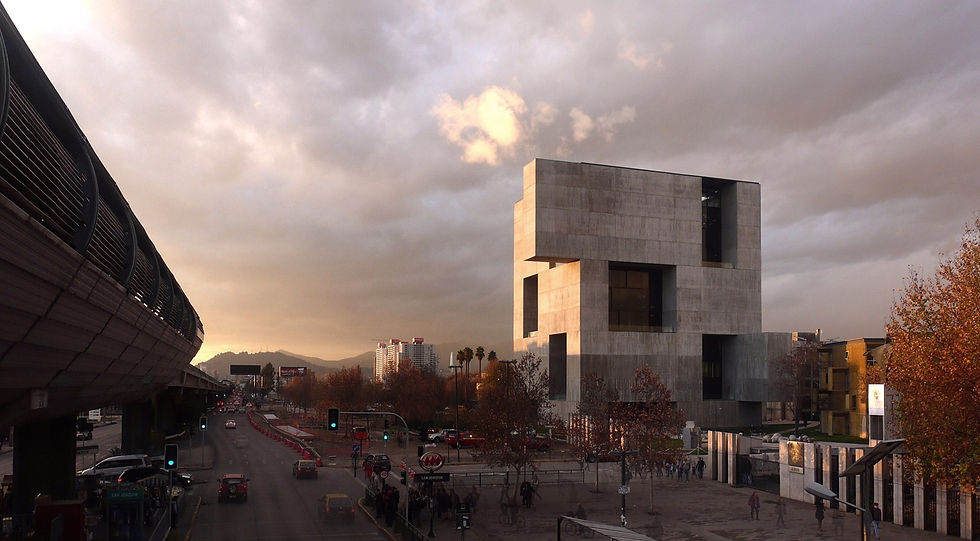
Towards Vicuña Mackenna Avenue, the edge of the campus forms the "face to the city," with buildings close to a higher-ranking pedestrian and urban mobility structure than those on the north and south edges of the campus, "facing" the only building not served by parking areas between the wall and the street. The Innovation Center.
Compared to the northern and southern edges, which have similar parking isolation conditions along almost 100% of the extension on Monseñor Carlos Casanueva Avenue and Pintor Benito Rebolledo Avenue, the eastern edge on Maratón Avenue has the greatest potential for integration at its northern end, mainly due to a portion of undeveloped land near the skate park and the possibility of integrating residential use. Meanwhile, at the southern and central ends, the campus park faces the sports area with its only building (veterinary medicine), in addition to the innovation center, which faces the street without segregating uses such as parking.
Accessing the campus
In an approach to the architectural scale, we explore the relationship between architecture and the city from the integrative perspective of Aravena and Elemental, where architecture is conceived not only as individual objects, but as part of a broader urban whole. This involves considering aspects such as accessibility, connectivity, and interaction with the urban environment as the objective of this second tour. We pass by the Anacleto Angelini Innovation Center, the Siamese Towers, and the Faculty of Mathematics, to see how the organization of their ground floors and their location manage to reflect this vision by organically integrating into the context, fostering interaction between students and faculty, as well as multidisciplinary collaboration.
The arrangement of these groups allows us to interpret some principles analogous to colonialist-influenced city-building practices. This creates a center that houses buildings for religious use, such as the Sacred Heart Temple and the theology library, along with other communal buildings, such as the San Joaquín Library, bookstores, banks, photocopying centers, and Lassen classrooms.
This center is shaped by the proximity of buildings and the internal separation generated by vehicular traffic within the campus. This is reinforced by the organization of geometric layouts that organize pedestrian traffic and converge radially toward the centers in some common areas.


As a starting point, the UC Anacleto Angelini Innovation Center emerges as a meeting place not only for researchers and academics, but also for entrepreneurs, representatives of the productive sector, and all those linked to innovation and entrepreneurship. Equipped with shared work areas on each level, meeting rooms, conference spaces, research laboratories, and exhibition areas with flexible layouts to adapt to the changing needs of innovation projects.
It stands as a monolithic landmark not only for the campus but also for the city, shifting its mass toward the facades to free up the center as a strategy to address issues of sustainability and timelessness. Its ground floor is clearly organized under this same logic of freeing up the center and extending the continuity of the public space at its main entrance, with the central void culminating in all the entrances, whose proportions provide a certain homogeneity between each one.

The Siamese Towers also stand out from the landscape with a striking typology: in this case, a computer center with a platform and a tower that branches out as a strategy to gain height within a project of just 5,000 m2. Its façade is composed of two layers: an exterior layer of weather-resistant glass and an internal layer of fiber cement with improved thermal properties. Between them, an air chamber acts as a chimney, expelling hot air through the Venturi effect, preventing the greenhouse effect.

The platform is developed on two levels, housing the buried plinth floor as a strategy for controlling light in the computer rooms and allowing it to be used above as a meeting space.

Finally, the Faculty of Mathematics, a building very different in height and proportion from the previous two, is located in a way that blends more closely with its surroundings. It has classrooms of various sizes, specialized laboratories, study spaces, offices for professors and researchers, and meeting areas arranged along a corridor through which they are accessed. Its relationship with the context is determined largely by a theme of hierarchy and the sense of depth in its main entrances that protrude from the laminar building.

The isolated nature of many campuses today may be related to the way they were initially located, generally on the outskirts of cities that gradually grew and embraced their layout. A current challenge is to reconcile these often imaginary lines, but reinforced by weighty decisions and sharp relationships between the private and public spheres that fragment cities. Educational infrastructures of this magnitude, rather than being "islands" of security, are integrated into the city's exchange processes, contributing to local life.

The question of choosing campuses or cities as urban entities that must adapt their configuration to the other raises the rhetorical question contemplated at the beginning of this article. Beyond seeking an answer, this question prompts reflection on this and other infrastructures that were once located on what were then the outskirts of cities and were configured in isolation as a response to their surroundings. Today, they are immersed in a consolidated fabric that warrants not only specific architectural interventions but also reciprocal and larger-scale interventions. These interventions also bring to the table other, more complex issues regarding the importance of private autonomy in projects that have such a strong urban character that they inevitably impact the public life of those who experience them.


Comments