
A Second Skin as a Second Chance | National Film Archive 21st Century by Rojkind Architects

Author: Pablo Vazquez.
A lover of discovering new places and a workaholic, in short, an architect.


PROJECT: National Film Archive 21st Century.
ARCHITECT: Rojkind Architects.
PHOTOGRAPHY: Paul Rivera and Jaime Navarro.
STRUCTURAL ENGINEERING: CTC Engineers
ROOF ENGINEERING: Studio NYL
LOCATION: Coyoacán, CDMX, Mexico.
M2: 49,000 m2 approx.
YEAR: 2014.
Did you know that, according to a medical myth, humans regenerate all of their cells every 7 years?
Lungs, heart, blood… We are essentially different people at a cellular level; similar to a snake that sheds its skin every six weeks. Both examples share the commonality of maintaining their essential identity; it's simply an external change that brings with it the opportunity for a new beginning. Just as humans and snakes shed their skin, this building by Rojkind Arquitectos took almost a year to acquire a second skin. It was a project that goes beyond simply showing films: rescuing memory, including the community, and defining itself as a cultural space that can integrate into the daily life of the city, but…
Why was this intervention necessary?

Since its founding, the National Film Archive has been the guardian of Mexico's cinematic heritage; however, its history is not without tragedy and controversy. Over the decades, the institution suffered fires and partial losses of material—events that highlighted the vulnerability of audiovisual archives—and fueled both the urgent need for conservation policies and public speculation about what was actually lost in each disaster.


Among the urban legends that have circulated since then, one of the most persistent points to the possible destruction of graphic records of the Tlatelolco massacre (1968)—recordings that, according to some accounts, were stored at the Cineteca Nacional and were irreversibly damaged in a fire. It is important to approach these claims with caution: many of them mix documented facts (real fires, inadequate preservation) with rumors and theories that require documentary and testimonial verification. What is certain is that the possibility of the loss of these and other archives—confirmed in various episodes throughout history—underscores the urgent need to invest in preservation, backups, and access policies that guarantee collective memory.
The intervention at the National Film Archive was not merely a programmatic expansion: it was a commitment to restoring cinema to its status as a public space. Rojkind Arquitectos took a significant but fragmented cultural institution and transformed it into an integrated cultural campus: theaters, an archive, outdoor spaces, a culinary offering, and a covered plaza that serves as a social hub. The idea was clear from the outset: to make the building inviting, to ensure that a visit to the Film Archive was an experience that transcended its primary function of screening films.
The Cineteca occupied an emblematic location in Coyoacán, but it did not meet the technical, conservation, and public access requirements of a contemporary film institution. The renovation program pursued several simultaneous objectives:

Modernize and increase projection capacity with new rooms and technological upgrades.
Proper preservation of the collection —climate-controlled vaults— and increasing its storage capacity.
Recover and expand the public square to create an urban and cultural meeting place.
Integrate complementary uses (cafeterias, shop, exhibition spaces, open-air amphitheater) that multiply the daily life of the place.
Solving mobility and parking problems without sacrificing public space: the project freed up surface area by burying or rearranging parking lots, returning areas for pedestrians and activities.
In summary... the program went from being a collection of technical needs to an urban integration strategy that puts the community at the center.

Architecture, materials and formal strategy
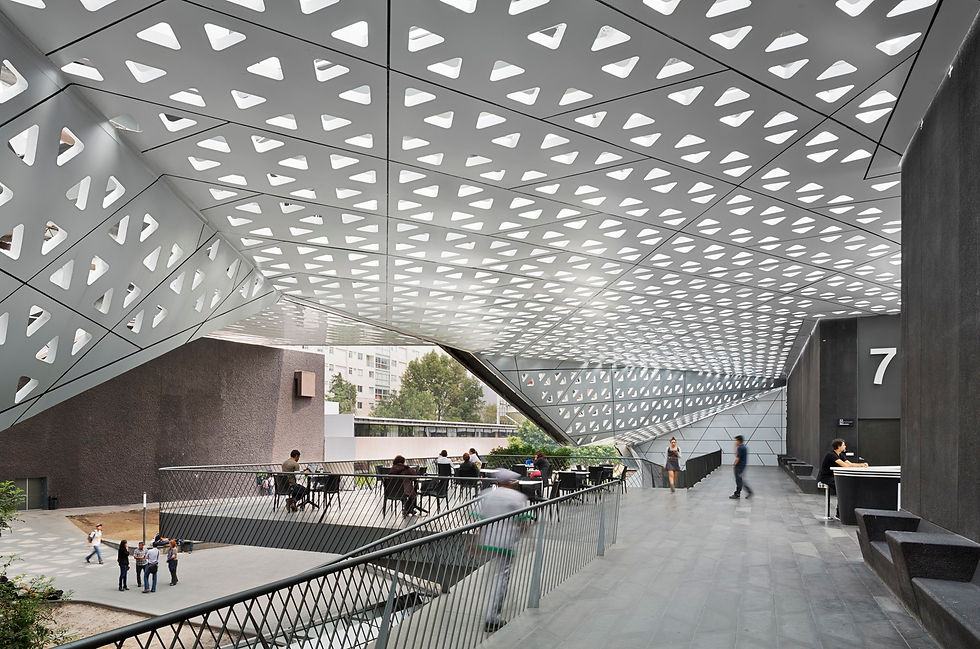
Rojkind's proposal integrates existing elements with new volumes through a large canopy/bridge that acts as a unifying element: it protects the plaza, connects pathways, and becomes the visual hallmark of the complex. The intervention respects the typology of cultural facilities but reinterprets it to achieve greater permeability and flexibility of use.
Materiality and texture

Concrete and steel make up the main structure —a powerful gesture that engages with the subject matter of cinema as an industry— while maintenance and new facades incorporate perforated metal elements and composite panels.
The roof was technically resolved with specialized contributions (roof engineering by Studio NYL), and its envelope acts both as a light filter and as climate protection.
The leg of the Plaza and the accesses use contrasting finishes: robust surfaces that convey solidity versus translucent or perforated materials that introduce lightness and light control.
Spatial strategy
The exterior facade, deliberately more "hermetic", directs the visitor towards the interior: the surprise of the public space discovered under the roof is intentional.

The circulation routes are organized to encourage descents and cross-flows between rooms, cafes and outdoor spaces; the plaza is the core and connector.
The interior-exterior relationship is addressed with patios, staircases and terraces that diversify the forms of use (from quiet walks to massive public functions).
Engineering and construction challenges

The magnitude of the canopy and the need to free up the land for public use required complex structural solutions (coordination with CTC Ingenieros for structure and with Studio NYL for roof).
The project resolved the coexistence between technical environments (conservation vaults require strict climate control) and public access spaces, reconciling thermal and acoustic requirements with the desire for openness.
4. Urban and social impact
The Cineteca became an urban catalyst, freeing up land previously occupied by parking and transforming it into a plaza and green spaces, thus changing the building's relationship with the neighborhood. The project improves pedestrian connections and revitalizes life around the Alameda and the surrounding area.

The increase in visitors has a positive impact on local businesses, cultural offerings, and the neighborhood's economic activity. A revitalized film archive generates a steady flow of visitors and events that support other activities.

The diverse programs—ranging from children's performances to international festivals—ensure the space is used by a wide range of people. The urban interpretation of the intervention—an institution opening its doors and transforming into a public square—returns an essential civic element to the city.

If I've already convinced you to go for a walk or see a movie, let me tell you…
Everything you need to know before you go

Address: Av. México-Coyoacán (Col. Xoco), Coyoacán, CDMX.
Access: Public transport (subway and feeder routes) and bicycles are recommended; the complex also has a reorganized parking area for those arriving by car.
Programming: daily performances, thematic cycles, festivals and public activities — check the official program before going.
On-site services: screening rooms, archive/vaults, shop, cafeteria, outdoor amphitheater and exhibition spaces.
Costs: Tickets to the Cineteca Nacional cost $70 pesos for general admission and $50 pesos for students, those under 25, and seniors. On Tuesdays and Wednesdays, general admission is $40 pesos; this price does not apply to sample screenings, the Forum, or Emerging Talent. Parking costs $40 pesos for cars and $20 pesos for motorcycles.
Extra : I recommend arriving early to explore the plaza and the exhibitions; many activities have limited capacity—purchase or reserve tickets in advance. For exact schedules and prices, please consult the Cineteca's official website.
The renovation of the Cineteca Nacional Siglo XXI exemplifies how a well-conceived intervention can transform a cultural facility into an urban catalyst: technical preservation of the collection, new cultural offerings, a public plaza, and social cohesion. The project demonstrates that contemporary cultural architecture works best when it considers community, preservation, and experience.
Which cultural space in your city do you think deserves a similar transformation?
I invite you to visit the Cineteca, enjoy a good film in an indoor or outdoor theater, and here are the plans for this project:


Comments