
Playing Is Also Learning | Children’s Bicentennial Park by ELEMENTAL

Author: Pablo Vazquez.
A lover of discovering new places and addicted to work—in short, an architect.
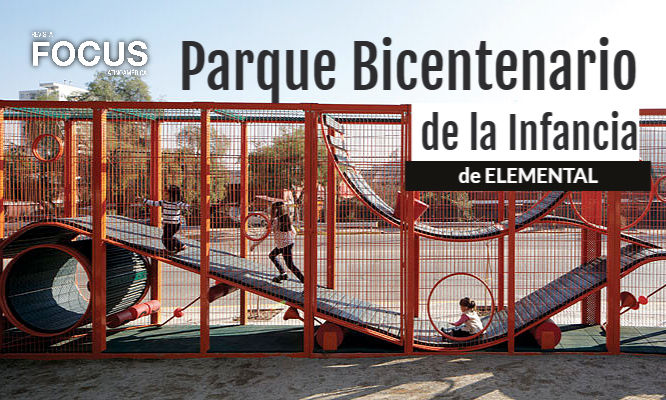
PROJECT: Children’s Bicentennial Park.
ARCHITECT: ELEMENTAL | Alejandro Aravena.
PHOTOGRAPHY: Cristóbal Palma.
LOCATION: Santiago, Chile.
YEAR: 2012.
AREA: Approximately 3.8–4 ha.
In cities, spaces designed for childhood are often small fragments within larger parks: a couple of swings, a slide, and a few plastic play structures. Places intended to fulfill a basic function, but which rarely become memorable experiences.
However, there are projects that rethink this logic and understand that play can also be a tool for learning, exploration, and development.
The Children’s Bicentennial Park, designed by the studio ELEMENTAL, led by Alejandro Aravena, is one of those cases. Located on the slope of Cerro San Cristóbal, within the Metropolitan Park of Santiago, Chile, this project transforms public space into a true territory of discovery for children and families.
More than a playground, it is an invitation to explore the landscape, interact with topography, and experience the city from another scale: that of childhood.
A Park Born from Geography

The project occupies approximately four hectares at the base of the hill, on a site that combines flat areas with steep slopes. Far from considering this topography a problem, the ELEMENTAL team decided to turn it into the project’s main resource.
Instead of leveling the terrain or imposing structures foreign to the landscape, the design adapts to the hillside through terraces, paths, and platforms, creating a continuous route where children can move freely.
This strategy resolves one of the most common dilemmas in the design of children’s areas: how to generate excitement without compromising safety.
The answer appears in one of the park’s most iconic elements: a large cascade of more than 40 slides that descend along the slope of the hill. Thanks to the natural inclination of the terrain, children can experience the sensation of height and speed without significant risks.
Here, topography becomes play.
A Public Space with Social Impact
But the Children’s Bicentennial Park is not only a recreational project. It also responds to a broader urban issue.
Santiago, like many Latin American cities, faces a historic deficit of green areas and accessible public spaces. The creation of this park is part of a strategy to expand the network of public spaces in the
Metropolitan Park and bring them closer to areas of the city that have traditionally had less access to them.
The park is located in the commune of Recoleta, near working-class neighborhoods that previously had few quality green areas. In this sense, the project functions as a redistributive act of urban space, where design becomes a tool to improve quality of life.
Architecture, here, is also political.
Playing with the Landscape

One of the most interesting aspects of the project is the diversity of experiences it offers.

The park is not limited to a single playground area, but proposes a series of interconnected scenarios that invite exploration:
Tree houses that allow visitors to observe the landscape from the treetops.
Water games organized in a “forest of spheres.”
Swings and musical games.
Sand and exploration areas.
Paths that wind between gardens and vegetation.
This variety turns the park into an open experience, where each route can be different.
Children do not only play: they discover, imagine, and build their own adventure.
A Boundary That Is Also Play

Even the most technical elements of the project are reinterpreted through the logic of play.
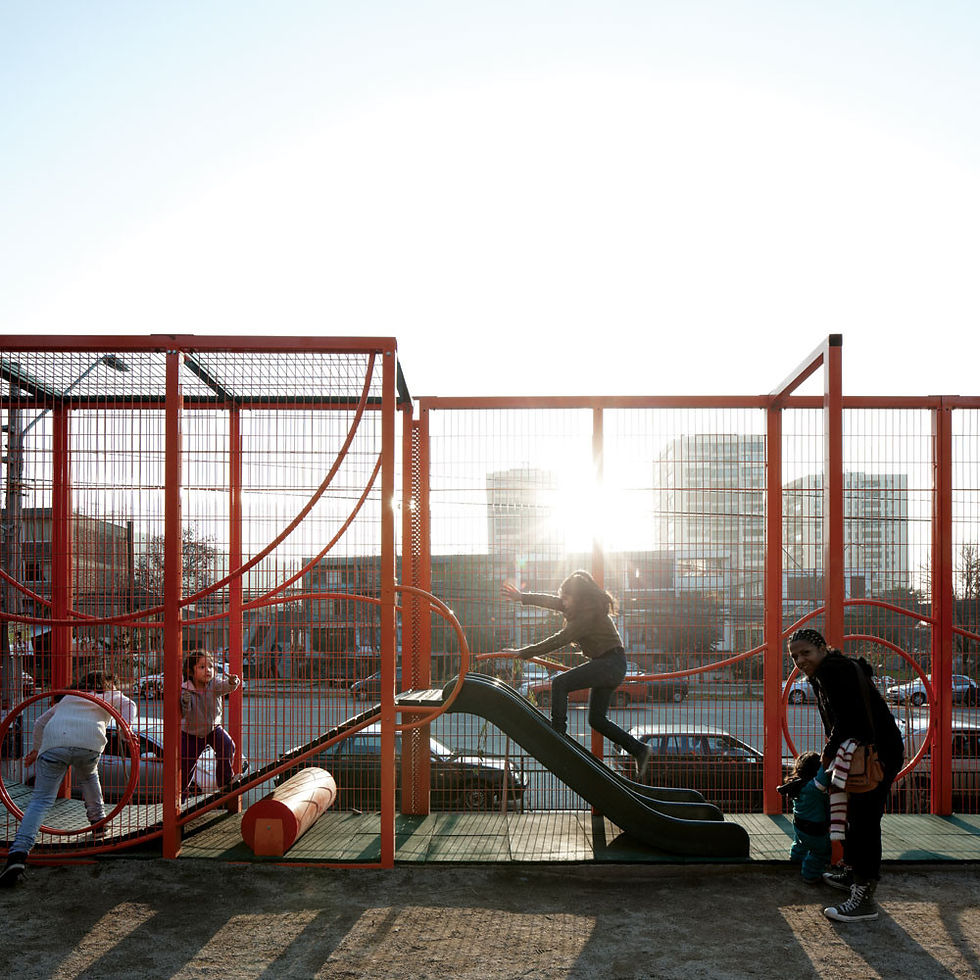
A clear example is the park’s perimeter enclosure, which normally functions as a rigid barrier between public space and the city. In this case, the boundary is transformed into a three-dimensional tube more than 300 meters long, through which children can move, climb, and explore.
What would normally be an element of control becomes, here, an extension of the play space.
These types of decisions show how design can transform even the most functional elements into opportunities for imagination.
Nature, Learning, and Community


The park also incorporates a strong educational dimension. Along its paths, native plant species and informational signage are integrated, allowing visitors to learn about the local ecosystem as they move through the place.
In addition, the project includes spaces for cultural activities, such as an amphitheater where theater and puppet shows take place, reinforcing the park’s role as a meeting point for families.
In this way, the park not only promotes play, but also coexistence, culture, and contact with nature.
Designing for Childhood Is Designing for the Future


The Children’s Bicentennial Park demonstrates that architecture for children can go far beyond traditional playgrounds.
Here, the design takes advantage of geography, integrates the landscape, stimulates imagination, and strengthens public space. It is a project that understands that children do not need simplified environments, but spaces that challenge their curiosity and encourage their autonomy.
In the context of an edition dedicated to childhood architecture in Latin America, this project reminds us of something fundamental:
When we design spaces for childhood, we are actually designing the experiences that will shape future generations.
Because in places like this, among slides, paths, and trees, parks are not the only things being built.
Memories are also being built.


Comments