
Can a Plaza Heal a City? | Jojutla Central Gardens of MMX

Updated: Dec 3, 2025
Author: Pablo Vazquez.
A lover of discovering new places and a workaholic, in short, an architect.

PROJECT: Jojutla Central Gardens.
ARCHITECT: MMX.
PHOTOGRAPHY: Dane Alonso.
LOCATION: Jojutla de Juárez, Mexico.
YEAR: 2019.
SQM: Approx. 9,144 m2
1. The heart that resists

In the center of Jojutla, one of the communities hardest hit by the September 2017 earthquakes, structures now stand that offer not only shade, but dignity. These are the central arches of the Jojutla Gardens, a project born not from the urgency of rebuilding, but from the need to heal. Because when a city is broken, the hardest part is not rebuilding its buildings, but recovering the soul of its people.
This space is not just a plaza: it is a testament to a community that chose to rebuild from its roots, with memory, participation, and conscious architecture.
2. A wounded city and the challenge of reconstruction

When the earthquake of September 19, 2017, struck the center of the country, few communities were hit as hard as Jojutla, in the state of Morelos. The scenes after the disaster showed a city torn apart: destroyed homes, closed schools, impassable streets, and ruined public spaces. But beyond the visible, the deepest damage was symbolic. Jojutla lost its meeting places, its community life, its urban identity.
In a community, public spaces aren't just for transit or rest. They are places where people meet, converse, celebrate, and connect. They are an extension of collective memory. When these are lost, what is fragmented is not only the physical environment, but also the social fabric.

Therefore, reconstruction could not be limited to building new structures. The city had to be reimagined from its most human foundations: dignity, encounter, belonging. Jojutla needed to recover its civic heart, not as a replica of the past, but as an opportunity to heal from the common ground. It wasn't enough to rebuild the space; trust in it had to be rebuilt.
And here arose one of the deepest challenges of the process: how to design a space that was not an external imposition, but a collective creation? How to respond to pain through architecture without turning it into a monument to suffering? The answer would be found in open participation, active listening, and a design that understood that true reconstruction is born from the connection between people and their space.
3. Architecture with a purpose: the Estudio MMX project

Given this scenario, Estudio MMX's brief wasn't simply to create a beautiful or modern plaza. It was to design a space capable of embracing a wounded community. From the outset, the architects—Jorge Arvizu, Ignacio del Río, Emmanuel Ramírez, and Diego Ricalde—understood that this would not be a traditional project. They couldn't, and shouldn't, work remotely.


The process was deeply participatory. Residents, neighborhood leaders, historians, public officials, and experts sat down to discuss the future of their city. It was an exercise in co-creation, where the ideas, concerns, and memories of the residents became real input into the design.
One of the project's most powerful metaphors emerged precisely from them: the trees that survived the earthquakes, standing tall among the rubble, steadfast amidst so much loss. These trees became a symbol of Jojutla's resilience, and based on them, a new concept for the urban center was conceived: not a plaza, but central gardens, where nature could accompany the process of emotional recovery.
This inspiration was translated into a green, open, and dynamic space that doesn't impose a single narrative but allows for multiple interpretations. It's a project that doesn't speak for the community, but with it. An example of humanitarian architecture that doesn't seek to impose technical solutions, but rather facilitate processes of listening, memory, and reconciliation.
In this dialogue between the technical and the symbolic, Estudio MMX achieved the most difficult task: ensuring that the design served not only the physical needs of the place, but also its collective soul.

4. The Arches and the Gardens: identity, function and form
At the heart of this project are the arches, structures that reinterpret the region's traditional architecture in a contemporary way. Far from being a decorative gesture, the arches were conceived as structural, symbolic, and functional elements. Their presence is solid but not imposing. They shelter without enclosing, they protect without isolating.

Each arch is based on a base module: a half-arch, whose orderly repetition generates an open and flexible system. Four half-arches form a larger unit, and the sum of these units establishes an architectural grid that runs through the garden. This system allows for the articulation of different spaces: from event areas and outdoor forums to shaded and relaxing passageways.
The use of materials was key to establishing a relationship between past and present. The handcrafted ochre brick dialogues with the natural landscape, while the gray basalt stone paving provides contrast and solidity. The vegetation, carefully selected from local species, not only beautifies but also reinforces the sense of ecological and cultural belonging.

The arches are not a visual whim: they respond to the climate, the context, and the community's needs. They create necessary areas of shade in an open space, while simultaneously generating a visual rhythm that guides the visitor's journey. During the day, the sun's rays pass through their voids and draw geometries on the ground. It is a sensorial experience that varies with the time, the light, and the season.
But the most valuable aspect of this architecture is that it does not impose a single use. It is multifunctional and open to community appropriation. It can be the setting for a rally, a local concert, an afternoon reading, or simply a shady meeting place. The arches and gardens of Jojutla are a reminder that well-designed public spaces not only beautify: they heal, connect, and transform.
5. Spaces for meeting: emotional architecture

But beyond the architectural language, what truly gives meaning to the place is its everyday use. Today, the residents of Jojutla have made this space their own: they walk through it, celebrate it, and inhabit it. The arches are not monuments: they are frames for daily life.
This project demonstrates that architecture can be an act of care. That when spaces are designed with empathy, what is built is not just infrastructure, but collective trust.
Because after the disaster, the most urgent thing was not to rebuild... but to believe again.
Would you like to see the arches in person?
Here's what you need to know...

If after reading all this, you're tempted to visit the Jojutla Central Gardens—and believe me, it's absolutely worth it—here's the essential information to help you plan your visit.
Where are they?
The gardens are located in the municipality of Jojutla, Morelos, about a two-and-a-half-hour drive from Mexico City. The drive is ideal for a weekend getaway, especially if you're looking to reconnect with a space that combines history, architecture, and nature.
When to go?
I recommend visiting in the morning or at dusk. At those times, the light passes through the arches and creates a spectacle of shadows and textures that changes as the day progresses. It's a visual interplay that brings the place to life and can't be appreciated in the same way at midday.
What to do once you're there?
Walk calmly along the paths. Stop in the shaded areas under the arches and let the design guide you.
If you're lucky, you might be able to coincide with a community event, from civic activities to local celebrations.
Take a moment to observe the materials: the brick, the stone, the vegetation... everything is designed to interact with the surroundings.
And if you're simply enjoying the present, sit on a bench, breathe deeply, and watch life go by. Because in a place like this, time seems to stop just so you can better appreciate it.
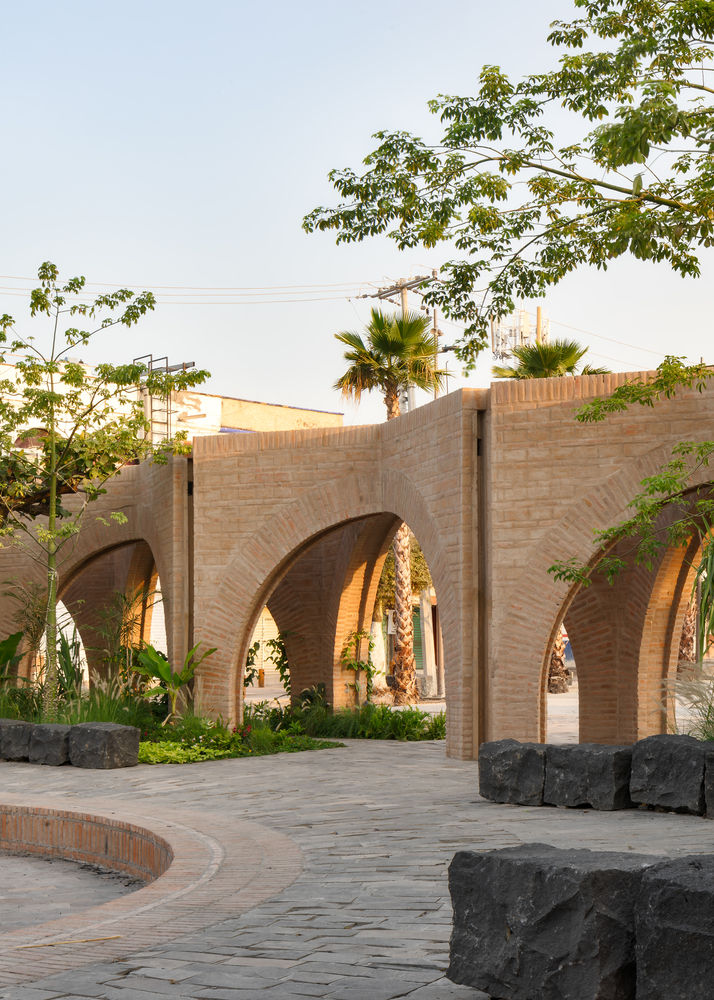
The Jojutla Central Gardens are not a tribute to tragedy, but to the life that persists. They are the result of an architecture that responds not only to pain, but to hope. A project where every brick, every shadow, and every tree planted carries with it a story of shared resilience.
Because rebuilding isn't just about raising walls; it's about reuniting. And in Jojutla, they succeeded.
REFERENCES:


Comments